
Text and photography by Nicolás Arias-Gutiérrez
Introduction
The Nyingma tradition (Tib. rNying ma, lit. “ancient”) of Tibetan Buddhism, following earlier Mahāyāna doctrines, has historically emphasized the emptiness of all phenomena, while simultaneously positing the immanence of the buddha-nature (or the enlightened mind) as the ultimate ground of reality. Radical conclusions drawn from these premises often appear confusing with their seemingly anti-practice rhetoric and rejection of all conceptualization. If the ultimate nature of all phenomena is the immanent, primordial purity of the mind or nirvāṇa, then: (i) what need is there for any kind of spiritual practice? and, (ii) why do human beings ordinarily experience saṃsāra instead?
In the context of Tibetan Buddhism, these and other doctrinal and practical problems could be said to form a complex web that has been historically associated to a polarity between two approaches to enlightenment: gradual (Skt. kramavṛttyā) and simultaneous (Skt. yugapat). Excellent sources for the study of the doctrinal and practical problems associated to this polarity can be found in the textual tradition of the Great Perfection (Skt. Atiyoga, Tib. rDzogs chen) of the Nyingma school. This is partly due to the fact that the teachings of the Great Perfection have been historically objects of some doctrinal criticisms by adversaries who claim that this tradition represents a subitist approach to enlightenment incompatible with basic Mahāyāna Buddhist doctrines. In response, Tibetan luminaries such as Rongzom (Tib. Rong zom Chos kyi bzang po, c. 11th century), Longchenpa (Tib. Klong chen pa, 1308–1363), and Mipham (Tib. Jam mgon Mi pham rgya mtsho, 1846–1912), have argued that the Great Perfection is not only compatible with the basic doctrines of the Mahāyāna, but also that it represents the ultimate teachings of the Buddhist dharma.
This thesis aims to provide an introduction to the study of some of these doctrinal issues and the hermeneutical challenges they pose on different levels. My approach will consist in (i) tracing the Indo-Tibetan roots of several problems that could generally be said to surface around the tension between gradual and simultaneous approaches to enlightenment; and (ii) analyzing the manifestations of some of these doctrinal problems in a Tibetan context, particularly in the formative stages of the Tibetan Nyingma tradition. I will draw references to the life and works of Rongzom, and particularly his treatise “Entering the Way of the Great Vehicle” (Tib. Theg chen tshul ‘jugy), to show the different levels of implications of the discussion, as well as some hermeneutical strategies employed to reconcile such tensions.
I argue that both gradual and simultaneous approaches to enlightenment have coexisted in the Nyingma tradition, where their presence has been explained with recourse to the concept of skillful means (Skt. upāya) and the idea of non conceptuality. Moreover, I suggest that an important part of the criticisms leveled agains the Great Perfection appear to be the reflection of fundamental doctrinal problems of Indo-Tibetan Buddhism, such as the tension between conceptually-determined and non conceptual modes of cognition and behavior.
Structural overview
In chapter one I provide essential context information about the Indian Mahāyāna and Vajrayāna traditions, necessary to understand the forms that Buddhism assumed in Tibet. I will begin by explaining some of the main ideas presented in the Perfection of Wisdom literature genre (Skt. prajñāparāmitā): the ideal of the bodhisattva and bodhisattva morality, emptiness (Skt. śūnyatā) and skillful means (Skt. upāya). This will be followed by an exploration of the theories of the buddha-nature(Skt. tathāgatagarbha), and a reference to the tantric assimilation of Buddhist concepts and practices. In some cases, references will also be made to the Tibetan reception and interpretation of these ideas.
In the second chapter, I present a concise account of the history of Buddhism in Tibet. The traditional narrative of gradual versus simultaneous in the context of the Samye debate will be given particular attention, as well as the question of possible connections between Chan and the Great Perfection, which appears to be at least partly related to the Indian sources of both traditions. This discussion will set the stage for the study of the formative stages of the Great Perfection that follows.
In the third chapter I provide a schematic introduction to the Great Perfection, identifying its main doctrinal points and some of their associated dichotomies, classifications and tensions. References to the context and themes of Rongzom Chökyi Zangpo’s “Entering the Way of the Great Vehicle”provide a more concrete point of reference for illustrating some points. I will also identify some hermeneutical strategies employed in the Nyingma school to explain simultaneist elements of the Great Perfection within the graduated path, while also navigating practical/pedagogical, doctrinal and political implications.
Finally, I conclude the thesis by pointing out the connection between some complex aspects of the Great Perfection and basic doctrinal problems of Indo-Tibetan Buddhism. I will explain how both gradual and simultaneous approaches are present in the Nyingma tradition, and how some of the controversies surrounding this polarity are merely apparent. I conclude by suggesting that the concept of skillful means may be seen in this context as a manifestation of the compassionate intention of offering spiritual paths leading to non conceptual realization of emptiness, adapting to the needs of different kinds of students.

Indian Antecedents
Indian antecedents: chapter overview
One of the fundamental teachings of Buddhism is that enlightenment is achieved through the knowledge of ultimate reality. Still, the Buddhist sūtras contain accounts of different teaching approaches that “do not necessarily appear to convey a consistent, unified philosophical vision” (Pettit 1999, 41), and different schools have debated more or less diverging interpretations of this ultimate reality. A rich Buddhist scholastic tradition thrived in the opening centuries of the common era, and as Buddhism expanded across East and Central Asia, the teachings of the Indian sages continued to spark further discussions (Blumenthal 2013, 89–90).
The first part of this chapter contains a brief summary of these developments in their historical context, focusing on the Perfection of Wisdom literature (Skt. prajñāpāramitā), the systematization of some of its doctrines in the works of the Madhyamaka school, and the sometimes divergent interpretations of the Yogācāra school. I will also explore in this section the idea of the buddha-nature, equally as important for the study of the Great Perfection. For the purposes of this exposition, I will follow Duckworth’s (2017) study of the Tibetan syntheses among the following three Mahāyāna doctrines: (i) the Bodhisattva ideal and morality, (ii) The doctrine of emptiness and the concept of skillful means, and (iii) the concept of buddha-nature.
The second and final part of the chapter introduces some basic notions that are essential for understanding the teachings of the Great Perfection in the context of the Indo-Tibetan Vajrayāna. In this section, I will briefly discuss academic hypotheses about the emergence of the tantric phase of the Mahāyāna, followed by a few terminological distinctions necessary to avoid ambiguity, and finally returning of the concept of skillful means, this time viewed from a Vajrayāna lens.
It should be kept in mind that the following characterization of schools or orientations is a simplified presentation of frequently complex and nuanced interpretations, and that my choices on the use of certain labels are not necessarily shared by all schools or teachers (Blumenthal 2013, 88). My purpose in this chapter is simply to point out some important concepts and themes that eventually provided a basic vocabulary and syntax for Tibetan hermeneutical attempts at negotiating fundamental doctrinal tensions.
The Mahāyāna
Historical context of the Mahāyāna
Even though not much is known with certainty about the origins of the Mahāyāna movement, scholars seem to agree that a variety of Buddhist sūtras known as the “Perfection of Wisdom” (Skt. prajñāparamitā) started to emerge and gain popularity around the 1st or 2nd century CE, marking the beginnings of the Mahāyāna textual tradition (Powers 2007, 103). These and other Mahāyāna sūtras emphasized: (i) the ideal of the bodhisattva as opposed to that of the arhat, (ii) a bodhisattva morality based on an ethos of great compassion (Skt. mahā-karuṇā), and (iii) a more radical stance in regard to ultimate truth, tied to the doctrine of emptiness (Skt. śūnyatā) (Pettit 1999, 41–45). It is important to keep in mind that some of these elements were already present in the earliest sources of the Pāli canon, and that monks who aspired to the bodhisattva and the arhat ideals appear to have lived peacefully together in early times (Pettit 1999, 43–44).
The Mahāyāna sūtras were eventually were interpreted, systematized and debated from a perspective of critical philosophy, leading to the development of highly sophisticated scholastic works. The schools that had the most enduring influence on the subsequent Tibetan traditions were the Madhyamaka and the Yogācāra, although the ideas of the buddha–nature (Skt. Tathāgatagarbha) are undoubtedly also at the heart of the Nyingma tradition. These key Mahāyāna ideas will be studied in more detail in the following three sections.
Important Mahāyāna doctrines
Bodhisattva ideal and morality
An undoubtedly significant shift in Buddhist religious thought occurred when the Mahāyāna movement put the accent on the ideal of the bodhisattva, a being who out of great compassion (Skt. mahā-karuṇā) for the suffering of others, vows to attain buddhahood and remain involved in saṃsāra to continue helping all sentient beings realize enlightenment (Blumenthal 2013, 86–87). The bodhisattva vow (Skt. bodhisattva–saṃvara) was a a Mahāyāna innovation that encapsulates this great commitment, made accessible also to lay practitioners, unlike the earlier monastic vows (Skt. prātimokṣa-saṃvara), (Wangchuk 2007, 46, 139). The titanic task ahead of the aspirant who takes the bodhisattva vow is traditionally said in the Mahāyāna to require eons of accumulation of merit and wisdom, but the aspirant is driven by bodhicitta (lit. “Mind of Awakening”), the firm resolution to attain buddhahood for the sake of liberating all sentient beings (Pettit 1999, 43). The central concept of bodhicitta is a unique characteristic of the Mahāyāna sources, where it is primarilyunderstood as the “crystallized” altruistic attitude and actions of a bodhisattva (Wangchuk 2007, 84).
Although the bodhisattva idealwas not unknown to earlier Buddhist traditions, it was perceived as an extremely difficult goal, pursued only by extraordinary individuals (Powers 2007, 111). The preferred ideal was that of the arhat, who strives towards individual liberation. Even though the arhat also trains in the development of moral virtues and gains insights into the emptiness of phenomena, the followers of the Mahāyāna considered this path to be lacking in terms of compassion and profundity of its understanding of emptiness (Snellgrove 2004, 62). The path of the bodhisattva is presented as a vastly superior alternative, leading to the cultivation of many more perfections and powerful abilities that will serve to amplify the beneficial effects of the bodhisattva’s radiant compassion (van Schaik 2016, 19–20).
With time, Mahāyāna followers began to use the term “Hīnayāna” (lit. “Small Vehicle”) to disparagingly refer to the approach of Buddhists who sought to attain arhatship instead of following the path of the bodhisattva. The term is used in this thesis due to the lack of satisfactory alternatives in doxographical discussions, but the differences in terms of ethical discipline among traditions should not be overestimated (Snellgrove 2004, 62).
The doctrine of emptiness and the concept of skillful means
The Perfection of Wisdom sūtras often presented their distinctive religious doctrines as being special teachings of the Buddha communicated secretly to select disciples, frequently bodhisattvas (Pettit 1999, 46). The ultimate validity of traditional Buddhist teachings is denied in some of these sūtras, with the Buddha himself explaining that they are not are not to be considered definitive, since the ultimate reality (i.e. emptiness), is ineffable and it is only accessible to those who transcend words and concepts altogether (van Schaik 2015, 29). However, the literal level of the canonical teachings was not completely denied; they were understood as having pedagogical value, even as provisional teachings corresponding to relative truth (Federman 2009, 125). In this sense, the earlier teachings of the canonical sūtras were understood as manifestation of the skillful means of the Buddha, who ably adapted his teachings to make them useful to a wider audience (Blumenthal 2013, 87).
The perfection of wisdom, a component of the bodhisattva’s path, captures the idea of direct realization of the ultimate truth (Powers 2007, 120). This perfection is considered supreme because its cultivation brings about a state of spontaneous development of all other perfections, maximizing the potential of the bodhisattva to help all sentient beings realize enlightenment (Snellgrove 2005, 91–93). The expression “skill-in-means” (Skt. upāya-kauṣalya), is often used in this context to describe the teachings and actions undertaken by bodhisattvas for this purpose (Powers 2007, 126). According to Federman (2009, 126–127), this Mahāyāna interpretation of this concept was built on a earlier idea of the Pāli canon: the teachings of the Buddhist Dharma are pragmatic in the sense that they are meant to lead to the cessation of suffering, so there should be no special clinging to them once they have served their purpose. The more elaborate notions of skillful means found in the Mahāyāna are more radical in the sense that they bring about a questioning of basic presuppositions about Buddhism, and religion more broadly (Federman 2009, 128).
Federman (2009, 125–126) has suggested that the concept of skillful means was given a very distinct sense in Mahāyāna circles and was employed in some contexts as a “radical hermeneutic device” for promoting new religious ideas. Moreover, Federman argues “that concept exhibits an awareness, not found in pre-Mahāyāna thought, of a gap between what texts literally say and their hidden meaning” (Federman 2009, 125). From this perspective, what falls out of the sphere of skillful means would be the definitive non conceptual teachings that point to the ultimate truth of emptiness of all phenomena, not immediately accessible to all practitioners (Blumenthal 2013, 88–89). Whether this strategy was used for political purposes, out of a genuine interest to resolve hermeneutical difficulties, or both, is a question that I wish to leave aside in this work. What I would like to underline here is a series of ideas and distinctions that are used in connection to the concept of skillful means to cope with hermeneutical challenges: (i) ultimate and relative reality (or truth), (ii) definitive and provisional teachings, (iii) literality and concealed meaning, and (iv) a distinction between the levels of ability of aspirants.
This will become clearer in the next few pages, as I review some significant scholastic developments of the Indo-Tibetan Madhyamaka and Yogācāra traditions.
The Mahāyāna developments on emptiness, skillful means, the bodhisattva ideal, and morality were subject to extensive scholarly elaboration. The Madhyamaka (lit. ‘Middle Way’) is the philosophical school that has arguably had the greatest influence on Tibetan Buddhism (Kapstein 2011, 5). It originated around the 1st or 2nd centuries CE in the works of Nāgārjuna, an Indian Buddhist sage who presented his interpretations of the Perfection of Wisdom sūtras in systematized form, also engaging in numerous doctrinal debates (Pettit 1999, 2–3). The name of the school derives from its self-presentation as philosophical middle way between the two extremes of eternalism and nihilism, as explained in the most influential text of this tradition: Nāgārjuna’s “Fundamental Verses of the Middle Way” (Skt. Mūlamadhyamakakārikā) (Blumenthal 2013, 90). Nāgārjuna’s doctrine of emptiness (Skt. śūnyatā) is based on the dichotomy between conventional truth (Skt. saṃvṛti-satya) and ultimate truth (Skt. paramārtha-satya), which was observed in the Perfection of Wisdom sūtras (Ruegg 2010, 40). In opposition to the approach of abhidharma, which distinguished between pure and impure dhārmas, Nāgārjuna argued that all dhārmas are ultimately empty, in the sense that they lack substantiality or intrinsic reality as independent or autonomous things-in-themselves (Snellgrove 2005, 82–83). On a conventional level, however, this emptiness is expressed as the dependent arising of phenomena (Skt. pratītya-samutpāda) and labelled conceptually as such (Pettit 1999, 3).
Dialectical philosophy, the approach of the Madhyamaka, consisted in critically examining and rejecting all logical alternatives of doctrines that posited the existence of self-existing phenomena (Pettit 1999, 3). In the next chapter, I will mention how elaborate systems of epistemology (Skt. pramāṇa) were later added to the Madhyamaka doctrines in the works of Śāntarakṣita, extending the discussion beyond the nature of ultimate reality to the valid sources of knowledge, both in conventional and ultimate senses (Pettit 1999, 3). From the Madhyamaka perspective, the purpose of this “apophatic” critical analysis is to induce in the aspirant a rational certainty that is compounded with meditative practice in the path to enlightenment (Pettit 1999, 3).
Having reviewed the main features of the Madhyamaka via negativa approach, I will now refer to more “substantialist” descriptions of the ultimate reality, as found in the Yogācāra school and the buddha-nature theories.
The Yogācāra school, best known for its doctrine of “mind-only” (Skt. citta-mātra), emerged as a later interpretation of the concept of emptiness, in the works attributed to the Indian sage Asaṅga and his brother Vasubandhu in the 4th century CE (Blumenthal 2013, 90, 92–93). Whereas the Madhyamaka school employed the distinction between conventional and ultimate knowledge to give shape to the concept of emptiness from a mainly ontological standpoint, thinkers of the Yogācāra school adopt a more “phenomenological” approach based on a distinction between three “natures” (Skt. trisvabhāva): (i) the dependent nature (Skt. paratantra-svabhāva), (ii) the constructed nature (Skt. parikalpita-svabhāva), and (iii) the perfected nature (Skt. pariniṣpanna-svabhāva). This distinction is drawn from a Mahāyāna scripture named the “Sūtra Unraveling the Thought”, where it is used by the Buddha to explain apparent contradictions between his earlier teachings and those found in the Perfection of Wisdom literature (Skt. samdhinirmocana sūtra) (Blumenthal 2013, 93). These concepts will now be explained briefly.
Yogācāra texts tend to emphasize the role of mind (Skt. citta) or consciousness (Skt. vijñāna) in human experience, showing how ignorance about the ultimate reality causes us to mistakenly perceive phenomena (Blumenthal 2013, 93). The doctrine of the emptiness of all phenomena is still central, but it is interpreted differently than in the Madhyamaka. Phenomena are said to be empty in the sense that there is no independence “in the relationship between an object and the consciousness perceiving it”, and this is known as the “dependent nature” (i) (Blumenthal 2013, 93). This concept is contrasted to the notion of the constructed nature (ii), which is basically the deluded view of objects as clearly independent of the consciousness which perceives them (Blumenthal 2013, 93). This mistaken view is said to be the source of suffering, which is to be cured by insight into the ultimate nature of reality. Finally, the perfect nature (iii) reflects this insight about how the ultimate nature of objects “as empty of independence from consciousness, empty of subject–object duality” (Blumenthal 2013, 93).
The Yogācāra view of the functioning of consciousnesses gravitates around two additional notions: the afflicted mentation (Skt. kliṣṭa-manas) and the “basic consciousness”, also translated as “storehouse consciousness” (Skt. ālaya-vijñāna). The process of perception of phenomena is explained as the sprouting of karmic seeds (Skt. bīja) and predispositions (lit. “perfumations”, Skt. vāsanā)the basic consciousness, a field that persists even in the absence of all mental processes (Germano and Waldron 2006, 37–41). Afflicted mentation is the name given to the deluded view of imputing a notion of self on the functioning of the basic consciousness (Blumenthal 2013, 94). In Higgins’ words, “that mind (citta), under the influence of defiled ego-mind (kliṣṭamanas), has both intentional (object-intending) and reflexive (‘I-intending’) operations that structure experience in terms of an ‘I’ (subject) and ‘mine’ (object)” (Higgins 2012, 446)”.
The discussion of Yogācāra doctrines about the actual functioning of human consciousness will continue in the following section, where I discuss their interpretation in Tibet in connection to the theories of the buddha-nature.
The notion of Buddha-nature
A very influential trend of Mahāyāna thought centered on the notion of buddha-nature (Skt. tathāgatagarbha, among other synonyms and quasi-synonyms) emerged from reflections on the capacity to attain buddhahood, and eventually solidified into more definite and elaborate forms. Wangchuk describes the Ratnagotravibhāga, a compendium possibly composed around the 4th century CE, as “the non-scriptural magnum opus that systematically presents the Tathāgatagarbha theory” (Wangchuk 2017, 95). Duckworth (2017, 128) explains the doctrine of buddha-nature (Skt. tathāgatagarbha, among other synonyms and quasi-synonyms) as “a characteristically Mahāyāna turn from transcendence to immanence”, that is expressed in Tibetan tantric terms as “liberation in saṃsāra”. A similar shift occurred in East Asia with Dogen’s teachings: from an understanding of the buddha-nature as something that exists in all beings, to an interpretation of this notion as equivalent to all beings (Duckworth 2017, 128).
Duckworth studies the Tibetan reception of Madhyamaka and Yogācāra thought and points out how the doctrine of the buddha-nature informed somewhat novel Tibetan interpretations of the Indian concepts (Duckworth 2017, 111). Moreover, Duckworth advances the argument that these syntheses are fundamental to Tibetan Buddhist thought, which he believes to have historically circulated around the “relationship between emptiness, as the transcendent nature of all things, and buddha-nature, as the immanent nature of the buddha in the world” (Duckworth 2017, 112).
First, in dialogue with the Madhyamaka doctrine of emptiness and “groundlessness”, the buddha-nature was equated to the positive aspect of emptiness, functioning as a positive foundation of reality for non-Geluk traditions (Duckworth 2017, 111, 115). This positive sense of emptiness came to be known in Tibet as the “other emptiness” (Tib. gzhan stong): phenomena are extrinsically empty of everything except “what remains when defilements are removed” (Duckworth 2017, 114). What remains is the buddha-nature. Sur further explains that the Nyingma tradition tends to see Rongzom as emphasizing this aspect of emptiness“according to the Old School tradition, “Rongzom is taken as a figure whose commentary on Great Perfection emphasizes the empty aspect”, but he also refers to the positive-mystical aspect that I now explain (Sur 2015, 229).
Wangchuk explains that even though the ideas of Yogācāra school are perceived in Tibet as being inferior to Madhyamaka, this is in part explained by the Indian hierarchical doxographical scheme that the Tibetans inherited (Wangchuk 2013, 1319). Upon close examination, however, Yogācāra ideas are seen to play important roles in the Tibetan tantric traditions (Duckworth 2017, 115). Wangchuk states that in Tibetan Buddhism the mind is always seen as the point of departure, although there are two main interpretations: “for some, what underlies the mind as its true reality is śūnyatā, and for others what underlies the mind as its true reality is the innate gnosis” (Wangchuk 2017, 89). I now turn to the second, “positivistic”, Tibetan interpretations of the mind that were shaped by interplay of buddha-nature and Yogācāra ideas, which have played a key role in the Great Perfection tradition, especially in the works of Longchenpa and Mipham’s synthesis (Sur 2015, 229).
In Tibet, the idea of the buddha-nature was understood to supplement Yogācāra ideas in two ways: (i) as being the potential for enlightenment, and also (ii) as being the “cognitive content of awakening” (a buddha’s cognition) (Duckworth 2017, 111, 127). Thus, the buddha-nature came to be seen as a positive basis for the Mind-Only doctrine, marking a shift from the earlier understanding of the basic consciousness (Skt. ālaya-vijñāna) as a mental structure that perpetuates cognitive distortion (Duckworth 2017, 111, 128). This positive gnostic ground of emptiness is found in non-Geluk traditions (Duckworth 2017, 116), such as the Nyingma Great Perfection teachings. In Duckworth’s words: “With the unfolding of absolute gnosis, the story of saṃsāra is rewritten by replacing the antagonist – karmic creation – with gnostic creativity in the lead role” (Duckworth 2017, 128). This gnoseological emphasis was overlaid on three key doctrines of the Yogācāra School: (i) the basic consciousness (Skt. ālaya-vijñāna), (ii) the dependent nature of reality (Skt. paratantra), and (iii) self-awareness (Skt. svasaṃvedana) (Duckworth 2017, 116).
In Tibet, the concept of the basic consciousness as gnosis (i) was initially associated to the doctrine of the truth-body (Tib. Chos sku, Skt. dharmakāya), in contrast to the basic consciousness as “universal ground” (buddha-nature in its unmanifest form) (Duckworth 2017, 120). With time, this distinction was discarded, as evinced in the works of Longchenpa, where the basic consciousness as gnosis is said to be “not the outcome of a transformative process, but as manifesting spontaneously once distorted consciousness is cleared away (Duckworth 2017, 121).
Regarding the idea of dependent nature (ii), a distinction is sometimes employed in Tibet between “impure dependent nature” and “pure dependent nature”. The former stands for “the distorted ground of saṃsāra”, as opposed to the pure appearance of the world, devoid of any conceptual elaborations (Duckworth 2017, 122). The pure appearance is described in positive terms, not simply as “a world of distortion, karma, and suffering to be shunned; but rather, a world of gnosis to be uncovered, recognized, and embraced” (Duckworth 2017, 122).
Finally, the gnoseological accent is also found in some Tibetan interpretations of the idea of self-awareness (iii), as evinced in the distinctions predicated between two modes of awareness, one distorted, based on subject-object polarity, and a superior non dual awareness that is “undistorted cognitive content, or gnosis” (Duckworth 2017, 127).
In conclusion, doctrines of the buddha-nature have had a profound influence on Tibetan Buddhism, leading to a particular understanding of the Yogācāra notions of basic consciousness, dependent nature and self-awareness. From this perspective, the pure ground and fruition of the path are indivisible buddha-nature (Duckworth 2017, 124). Moreover, the expression “becoming a buddha” could be understood to mean “directly experiencing the ontological buddha, true reality, by means of the gnoseological buddha, the profoundest meditative insight” (Wangchuk 2007, 56).
The Vajrayāna
Tantras, tantric practices and tantrism
Larson traces the first use of the Sanskrit term tantra to the Ṛg Veda, where it is used only once, in the sense of a ‘loom’ and the fabric on the loom (from the Sanskrit root tan), and perhaps associated notions of ‘extending’ or ‘stretching’(490). Later, in intellectual settings, the term tantra apparently meant a “learned system or śastra in which all of the component parts are placed in their proper systematic place”, examples of which were Yoga, Āyurveda, and Vyākaraṇa (Sanskrit grammar) (Larson, 490). The methodological devices studied and employed to compose tantras, in this sense of ‘learned traditions’, were called tantra-yuktis, which included “coherency and consistency” (Larson, 490).
Larson then explains how this apparently clear sense of the word tantra seems to have mutated around the 6th century CE, when an “explosion” of a genre of literary works related to magic and mysticism, such as the Śaiva āgamas, appears to have taken place (491). A distinction then arose between the terms vaidika and tāntrika, understood as two forms of approaching the ultimate reality differentiated by whether the revelation was formally rooted on the Brahmanic tradition or not (Padoux, 18). Larson, who believes that the term vaidika was used more in the sense of “conventional” or “traditional”, provides a very informative list of some of some distinctive features of texts referred to as tantras: (i) desire for worldly experience instead of salvation; (ii) interest on the modalities of desire; (iii) the idea of liberation while living in this world; (iv) importance given to attaining siddhis; (v) transgressive ritual practices (either visualized or performed physically) including sex; (vi) reference to a multitude of fearsome deities; (vii) practices that seek to establish a link between the microcosm (body) with the macrocosm; and (viii) the use of sacred sounds in the context of prayer and/or magic (491-492). The presence of “tantric features” is largely a matter of degree, and even then, some features may be absent in one text and present in another.
Padoux explains how this phenomenon began to be studied by the end of the 19th century by Western Indologists, who coined the term “Tantrism” (17). These scholars believed that the contents of these texts called tantras (the texts themselves usually didn’t identify as such) were very different to a more orthodox field of Indian philosophy and religion with which they were more familiar, and this led them to believe that “tantrism” was a phenomenon that could be neatly defined (Padoux, 17). Nevertheless, Padoux explains that this is a “vast, diffuse and diverse” phenomenon that defies clear-cut categorizations (18-23). Thus, the list of eight characteristics of tantra that Larson provides is heuristically useful to get a general idea of the use of the term tantra, but it should be kept in mind that in this context we are dealing with mainly an artificial category of academic discourse. Padoux’s view of Tantrism as simply the various forms that Hinduism or Buddhism took during history: “Depending upon the background, the origins, and the local influences, the evolution was more or less marked by a rejection of the orthodox Vedic rules and notions; it included more or less local autochthonous cults and beliefs, local religious behaviors, and magical and/or other practices” (23).
Acknowledging the social and historical complexity of the field of the tantras, I would like to focus exclusively on some forms of tantric Buddhist meditation, the aspect that is most closely related to the Great Perfection. According to Powers (2007, 252), the Buddhist tantras appeared in India between the 7th and 12th , and possibly later, but they only began to be translated in the 8th century. In Buddhist circles, the term tantra is associated to a genre of revealed scriptures with a distinct “soteriological approach or conveyance (yāna), the Vajrayāna or “Indestructible Vehicle” (Pettit 1999, 3). From a distinctly Buddhist perspective, Pettit perhaps adds a new element to Larson’s explanation of the term tantra when he explains Vajrayāna meditation as being based on “the principle of the immanence of ultimate reality, which is a coalescent continuum (tantra, rgyud) of gnosis (jñāna, ye shes) and aesthetic form (rūpa, gzugs, snang ba)” (Pettit 1999, 3). The components of this characterization will become clearer in the next section, where I explain the tantric emphasis on skillful means.
Skillful means in the Tibetan Vajrayāna
Although it has also been presented in the context of critical philosophy, the Tibetan tantric Buddhist approach holds direct experience or gnosis to be superior to the dialectical philosophical approach characteristic of the Madhyamaka (Pettit 1999, 41). This idea was illustrated by contrasting Vajrayāna to the so-called ‘Vehicle of Philosophical Dialectics’ (Skt. lakṣaṇayāna), a dichotomy which frames the discussion in terms of method (Skt. upāya), and more specifically the roles of rational analysis and gnosis in realizing the ultimate truth (Pettit 1999, 41). The Vajrayāna understanding of skillful means is based on the doctrine of “sameness” of saṃsāra and nirvāṇa, a corollary of the Mahāyāna doctrine of emptiness and its rejection of differences between pure and impure dhārmas (Powers 2007, 261). If all dhārmas are primordially pure, then gnosis has the potential to arise in any field of experience, and the tantras offer skillful means to make use of all energies of the aspirant on the bodhisattva path (Powers 2007, 257). These tantricteachings are presented as a series of secret and highly efficacious methods used to bring about enlightenment in a radically shorter amount of time than the three incalculable aeons of the bodhisattva path (Powers 2007, 250). The basic tension of gnosis and reason is at the heart of several Nyingma defenses of the Great Perfection and will be studied in more detail later.
It is also important to understand the role of the Mahāyāna doctrines of the immanent buddha-nature (Skt. tathāgatagarbha) for comprehending the primacy of gnosis in the Vajrayāna. From a tantric perspective, the ultimate reality is described as “pervasive, unfabricated presence of divine form, divine sound, and gnosis-awareness” (Pettit 1999, 3). In this context, the skillful means of tantric meditation would afford the possibility of spontaneous arising of gnosis by inducing a cessation of everyday human conceptuality (Pettit 1999, 3).
Buddhism in Tibet
Buddhism in Tibet: chapter overview
In this chapter, I review some significant milestones of the development of Buddhism in Tibet between the 8th and the 11th century, setting the stage for the third chapter, where I introduce some relevant aspects of the Great Perfection tradition, in connection to Rongzom’s 11th century treatise “Entering the Way of the Great Vehicle”. In this exposition, I pay special attention to the traditional accounts of the Samye debate and the possibilities of connections between Chan and the Great Perfection, since these topics present opportunities to discuss some of the doctrinal tensions of the Mahāyāna and Vajrayāna in a Tibetan context.
The Imperial age and the first diffusion of Buddhist teachings
The Tibetan emperor Trisong Detsen (Tib. khri srong lde btsan, c. 8th century) is believed to have proclaimed Buddhism as the official religion (Sur 2017a, 3) of a vast territory that extended beyond the Himalayan plateau, inviting teachers of monastic and tantric lineages to teach the dharma. Two key figures in the traditional accounts are the monk Śāntarakṣita (Tib. Zhi ba ‘tsho) and the tantric master Padmasambhava, also known as Guru Rinpoche (Tib. Pad ma ‘byung gnas). Due to difficulties in establishing a major temple, and upon recommendation by Śāntarakṣita, the emperor is said to have enlisted the aid of Padmasambhava, who “performed the original taming of the deities of Tibet and bound them to the service of the Buddhist teachings”, thus enabling “both the Buddhism and civilized life to be established within Tibet” (Samuel 1993, 220, 434). At this point, Śāntarakṣita is said to have returned to Tibet to supervise the foundation of the first monastery at Samye (Tib. bSam yas) and ordain the first Tibetan monks (Snellgrove 2004, 430).
It is significant that Śāntarakṣita is also credited for his doctrinal attempted at reconciling and systematizing his view of both the Madhyamaka and the Yogācāra streams of thought (Blumenthal 2013, 95). Blumenthal argues that Śāntarakṣita may be seen as representative of the final major in Indian Mahāyāna philosophical thought, due to his skillful amalgamation of ideas of both Madhyamaka and Yogācāra schools with the later epistemological theories (Skt. pramāṇa) of Dignāga and Dharmakīrti, such as “theories of perception, use of inferential reasoning, acceptance of the reflexive awareness (svasaṃvedana) of consciousness, and rejection of objects that are utterly distinct from consciousness (Blumenthal 2013, 95). In Blumenthal’s words, “Śāntarakṣita’s approach was to incorporate Yogācāra ideas into a Madhyamaka two truths framework at the stage of conventional truth, and a fundamentally Madhyamaka analysis was employed in presentations of ultimate truth” (Blumenthal 2013, 95).
Śāntarakṣita’s disciple Kamalaśīla (Tib. Pad ma’i ngang tshul) is not only known for a similar doctrinal synthesis of Madhyamaka and Yogācāra (Blumenthal 2013, 95), but is also considered a central figure in traditional accounts of the early stages of Buddhism in Tibet as a protagonist in the so-called “Samye debate”, the topic of the next section.
Simultaneous and gradual in the Samye Debate
Some of the doctrinal problems studied in the previous chapter lie at the very center of a famous episode in traditional historical accounts of early Tibetan Buddhism. Tibetan sources mention a doctrinal debate said to have taken place at the Samye monastery at the end of the 8th century CE (Samuel 1993, 451–452). The context of the debate seems to be that Moheyan’s teachings, and their reported rejection of all forms of duality and conceptual thinking, were seen as incompatible with the Indian Mahāyāna emphasis on the accumulation of merit and practice of analytical philosophy (Demiéville 1952, 11–12, 157).
A widely disseminated version of the most influential source, “The Testimony of Ba” (Tib. dBa’ bzhed), recounts that the emperor Tri Song Detsen convened a debate to decide which of two Buddhist approaches was superior and should therefore be officially taught and practiced in Tibet (Demiéville 1952, 11). On one side, the Indian scholar Kamalaśīla advocated for a gradual approach to enlightenment by means of the myriad practices of the Buddhist sūtras and tantras (van Schaik 2015, 14). This gradual path involved the cultivation of successive “perfections” through the accumulation of merit and wisdom in ten stages (Skt. daśa-bhūmi) (Demiéville 1952, 334, 348–353). His opponent was a monk remembered in the tradition as Heshang Moheyan (Tib. Hwashang Mahayan, lit. “Chinese Monk”), who has been often presented as having taught no practice other than nonmentation (Skt. amanasikāra), suppressing the arising of all thoughts and making the mind blank “like an egg” (van Schaik 2007, 5). Moheyan’s view of the goal was that of a sudden enlightenment that simultaneously encompassed all the perfections of the gradual path (van Schaik 2004a, 15–16), but it was not as naïve as it appears in many traditional accounts. I have already explained hin the first chapter how the distinction between conventional and ultimate truth was employed in Mahāyāna sūtras to frame practices of gradual cultivation as ultimately empty, which is not to say that they are not useful on the path towards the cessation of suffering.
After both sides had expressed their views, the gradualist, Indian side of the debate represented by Kamalaśīla was proclaimed as possessing the highest teachings, while the subitist doctrine of Moheyan was officially rejected (van Schaik 2015, 15). The image of the decisive defeat of subitism and the proclamation of the gradual approach as supreme has lived on in the Tibetan collective memory (Samuel 1993, 451–452). Although there seems to be growing agreement in recent scholarship that some kind of debate did indeed take place, at least as a series of written exchanges, a historical reconstruction of the arguments is impossible, because the scarcity of sources and concerns about their reliability leave ample room for uncertainty (Powers 2007, 150). For instance, a diametrically different account of the debate is contained in a Chinese manuscript found in the early 20th century in caves outside the city of Dunhuang in modern day China (van Schaik 2015, 15). In this version, Heshang Moheyan is proclaimed the victor, with the Tibetan Emperor officially recognizing the validity of the Chan teachings and authorizing their diffusion (Demiéville 1952, 178).
In any case, it seems like the historical influence of Chan in Tibet extended beyond the supposed date of the debate, being taught at least until the 11th century, but ultimately falling into obscurity around the 13th century (Van Schaik 2012, 16). Through the centuries, the figure of Heshang Moheyan has been frequently caricaturized to both criticize and defend doctrines that underlined non conceptual awareness, or seemed to endorse subitist ideas or practices of nonmentation (van Schaik 2007, 1–2).

Possible connections between Chan and the Great Perfection
The Nyingma teachings of the Great Perfection have been subject to criticism on the grounds of being too close to the subitist doctrine of nonmentation attributed to Moheyan (van Schaik 2004a, 15–16, 339n220). Among other reasons, such arguments have led contemporary scholars to speculate about the possibility of a connection between the Great Perfection and Chinese Chan, a hypothesis that appears to have been first formulated in 1958 by Giuseppe Tucci, an early pioneer of Tibetology (van Schaik 2012, 5–7).
In a recent article on the topic, Van Schaik expresses skepticism about the possibility of Chan surviving in Tibet under the form of the Great Perfection, and argues that the similarities can be partly explained by the fact that “both are meditation traditions based on the direct access to one’s own enlightened nature” (van Schaik 2012, 5). More specifically, he points out that Chan and the Great Perfection share the influential distinction between conventional and ultimate truth found in the Perfection of Wisdom sūtras, as well as the terminology of texts such as the Laṅkāvatāra Sūtra (van Schaik 2012, 10–11).
This shared basis could be seen to explain, at least to an important degree, some similarities that have been observed between Chan and the Great Perfection, such as: (i) the emphasis on the mind and its connection to the idea of emptiness; (ii) terminology and metaphors based on imagery of the sky; (iii) the primacy of direct insight into the ultimate reality over scholastic pursuits, and (iv) references to spontaneity (van Schaik 2012, 8, 10). Van Schaik suggests that the few real convergences that remain after a careful philological analysis may be explained by the fact that the tantric sources of the Great Perfection terminology (e.g. the Guhyagarbha tantra) “are themselves steeped in the terminology of the sūtras that inform Chan discourse (like the Laṅkāvatāra)” (van Schaik 2012, 10).
Moreover, van Schaik adds that the question of influence of Chan on the Great Perfection, as well as the attempts at differentiating them can easily fall into an “ahistorical reification” of these traditions: “During the eighth and ninth centuries, neither Dzogchen nor Chan had yet developed an identity that would allow them to be considered in separation from the cultures of Buddhist praxis in which they were embedded” (van Schaik 2012, 6). Later, the processes of reification did happen in the tradition of the Great Perfection, with scholars eventually following in the grooves of the traditional commentators in their attempts to differentiate it from Chan (van Schaik 2012, 5–7). In his own analysis, van Schaik refers to several Dunhuang manuscripts and concludes that instead of one tradition influencing the other, it seems like both converged in being applied to the practice of deity yoga (van Schaik 2012, 7, 14). Evidence in the Dunhuang manuscripts that seems to point to a more fluid transmission of Indian and Chinese teachings between the 8th and the 10th centuries, when Chan appears to have been taught alongside Buddhist Tantra in Tibet (van Schaik 2012, 7, 16). Therefore, instances of “cross-pollination” between Chan and the Great Perfection are still a possibility, although the shared basis of both traditions may effectively account for the “family resemblances”.
In several ways, the traditional Tibetan account of the debate found in the Testimony of Ba is framed as false dichotomy. As explained in the previous chapter, the Perfection of Wisdom sūtras repeatedly acknowledge the importance of ethical practice and meditation from the level of conventional truth, but also claims that these practices are all empty of any real existence when examined from the perspective of the ultimate truth. The Chan teachings are therefore misrepresented in some Tibetan accounts when Moheyan’s is said to reject the practice of the six perfections as unnecessary (van Schaik 2015, 136–137). It is also evident that Chan teachings are grossly overgeneralized in the figure of Moheyan as being exclusively based on the single method of nonmentation.
To summarize, Van Schaik (van Schaik 2012, 15–16) believes that around the 8th century teachers of Chan texts in China, and teachers of the Great Perfection texts in Tibet were engaged with texts and practices of tantric buddhism. He suggests that later, around the 10th century, “these parallel developments converged, at least in the context of Tibetophone Buddhist practitioners, when both Chan and the Great Perfection were being practiced in the context of the three concentrations of Mahāyoga sādhanas” (van Schaik 2012, 15). Nevertheless, I believe that the question of influence should remain open until more historical evidence about such interactions comes to light.

The Tibetan Renaissance and the new dispensation
The Imperial period, during which the political patronage allowed a rich Buddhist tradition to flourish, stretched approximately between the years 650 and 850, and was followed by the collapse of the Tibetan empire and the period of political fragmentation that ensued (circa 850–950) (Davidson 2005, 2). Monastic lineages dwindled, but rich local lay traditions survived and even thrived (Sur 2017a, 4).
After their decline during the age of fragmentation (c. 850-950), monastic traditions had regained foot in Tibet by the end of the 11th century, supported by an intense translation project and the dissemination of a great variety of new teachings that were being imported from India (Sur 2017a, 4). The influx of new teachings and their interactions with the surviving Buddhist (and Bön) lineages brought about a “Tibetan Renaissance” that stretched from the 10th to the 12th century (Davidson 2009, 2).During this time, sectarian identities started to coalesce as the old (Tib. rNying) transmissions of the Imperial era were dismissed by some of the promulgators of the new (Tib. gSar) lineages (Davidson 2005, 211). In response, the adherents of the old traditions claimed the superiority of the teachings transmitted during the Imperial era, associated to an image of old glory (Sur 2017a, 4).
Van Schaik has argued that some similarities can be found between the Great Perfection and the tantric lineages of the second dispensation that were brought to Tibet in the 11th and 12th centuries, which stressed the view of non concepualization and the immanence of buddhahood in the context of spiritual practices (van Schaik 2004b, 200–201). In his opinion, the tension between ritual or meditative practice and a “view” that transcends both practice and result seems to have characterized Indian Buddhist tantra in its terminal phase, a trend that was perpetuated in Tibet (van Schaik 2008).
The issues surrounding the polarity between gradual and simultaneous approaches to enlightenment were being discussed in Tibet as sectarian identities were beginning to emerge in the 11th century. The writings of Rongzom (Tib. Rong zom Chos kyi bzang po), introduced in the following section, contain sophisticated discussions of the Great Perfection that touch on some doctrinal problems issues associated to the gradual and simultaneous polarity.
Rongzom Chökyi Zangpo
Rongzom is a key figure of the Tibetan Renaissance, who played an important role in the formative stages of the Nyingma tradition towards the end of the 11th century (Sur 2017a, 6). He is renowned in the tradition not only for translating Sanskrit texts, but also for possessing an extensive knowledge of Buddhist doctrines, writing treatises and texts on a great variety of topics “from Sanskrit grammar to epistemology to the Buddhist sūtras to dairy farming, from the ethnographic to the phenomenological.” (Sur, 2017a, 7). Rongzom is not only remembered as highly educated intellectual, but also as a lay tantric adept of the highest caliber, “endowed with profound and therapeutic spiritual insight” (Sur, 2017a, 7).
During this period of Tibetan Renaissance, many were busy comparing, contrasting, and attempting to reconcile a growing variety of approaches to spirituality, with both pedagogical and polemical purposes (Davidson 2005, 155–157). Rongzom stands out for his prodigious literary output, at a time when there was a general suspicion and even antipathy towards religious compositions by Tibetans (Sur 2017a, 7). Dominic Sur, who has done extensive research on the life and works of Rongzom, describes him in the following terms:
“Rongzom was an early and resolute voice for the centrality of philosophical discourse in the Old School. He was also deeply concerned with the ethics of teaching and religious discourse both in terms of theory but also in terms of social practices” (2017b, 25).
In his study of Rongzom’s Charter of Mantrins (tantric practitioners), Sur further explains Rongzom view of the preservation of the local religious community as something that is achieved “through proper practice of ritually embodied forms of life, such as the tantric feasts (ganacakra, tshogs); and through a disciplined philosophical ethic” (Sur 2017b, 25–26). Rongzom espoused a variant of Madhamaka philosophy called “Sarvadharmāpratiṣṭhānavāda”, which is structured on a radically “negativistic ontology” (Wangchuk 2017, 87). Nevertheless, as Wangchuk explains, “for Rong-zom-pa, Sarvadharmāpratiṣṭhānavāda does not represent a single system in the doxographical hierarchy but rather a broad spectrum of it, both from sūtric and tantric sources” (Wangchuk 2017, 92).
Wangchuk (2017, 91) lists five distinctive features of the Sarvadharmāpratiṣṭhānavāda school: (i) a special ontology, (ii) a special soteriology, (iii) a special gnoseology (understood as a “theory of liberating insight”), (iv) a special cosmology, “or perhaps a special phenomenology”, and (v) a special psychology (explained as the “cognitional, emotional, and conational factors” of human behavior). Out of these five, Wangchuk highlights the ontology (i), which consists in the “doctrine of the indivisibility of the twofold truth/reality (bden pa gnyis)” (Wangchuk 2017, 91). This doctrine of indivisibility (Skt. nītārtha) is the shared ground between the “Sūtric-Mahāyanic system” and the system of the Great Perfection, two ends of the Sarvadharmāpratiṣṭhānavāda acceptance of the doxographical spectrum (Wangchuk 2017, 92). This doctrine of indivisibility could be described as the “substratum-less-ness of all saṃsāric and nirvāṇic phenomena” (Wangchuk 2017, 98). This is not necessarily a novel interpretation; Wangchuk (2017, 95) has shown that this conclusion is valid from the perspective of the Ratnagotravibhāga, the compendium of buddha–nature literature that was mentioned in the first chapter of this thesis. Nevertheless, I will leave this issue aside in my study of Rongzom’s work due to its doctrinal complexity.
“Entering the Way of the Great Vehicle”
Rongzom wrote his treatise (Skt. śāstra, Tib. tenchö) “Entering the Way of the Great Vehicle” (Tib. Theg chen tshul ‘jugy) in defense of the Nyingma tradition of the Great Perfection, considered the pinnacle of this school’s tantric approach. It is important to clarify that the expression “Great Vehicle” is in this context ““all-embracing rubric that includes” many of the streams of thought reviewed in the previous chapters both exoteric and esoteric (Sur 2017a, 10).
In this text, the role of different components of Buddhist spirituality, such as discipline, intention, and morality are given careful consideration against the background of considerably abstract doctrines. In view of this, Sur’s warning that this work was probably not meant for an audience of beginners is not surprising (Sur 2017a, 11). Based on the historical context, Sur speculates that the treatise was addressed at the proponents of the New Schools, although the only explicit reference is to “people who are obsessed with treatises on grammar and logic” (Sur 2017a, 4, 12). Straddling both the Old and New dispensations (Sur 2107a, 5), Rongzom was in a unique position to address critics of the emerging Nyingma Great Perfection, and he did so by adopting an inclusive approach:
“exploring the doxographical systems of Indian Buddhism and offering systematic formulations of how they relate, which includes utilizing the Great Perfection—an object of criticism for some proponents of the New Schools—as a lens into those doxographical systems, the most powerful lens.” (Sur 2017a, 13).
The political dimension of Rongzom’s hermeneutical attempts at achieving a rapprochement between the Great Perfection and the doctrines of the“Great Vehicle” is evident when seen as a response to criticisms of an ascendant political faction of West Tibet (the court of Yéshé Ö), whose purpose was to “to project temporal and religious power and fashion themselves as guardians and patrons of true religion” (Sur 2017a, 4). In addition to this political aspect (i), Rongzom’s arguments also had important implications on two other levels: (ii) practical/pedagogical and (iii) doctrinal. This is especially due to the fact that during this period of time the Nyingma “response” to the influx of new knowledge tended to assume the form of visionary revelations tied to stories of the Imperial Age, esoteric doctrines and practices (Sur 2017a, 5). In this respect, Rongzom’s systematic exposition constitutes a milestone of the Nyingma school, both doctrinally and pedagogically.
A full exploration of the text is currently exceeds my abilities and is beyond the reach of this thesis, but I will examine some of the treatise’s most important topics in the next chapter, where I discuss key aspects of the Great Perfection. What follows is an outline of the six chapters of Rongzom’s treatise based on Sur (2015, 109–110; 2017a, 9–35), meant to serve as a segue into the third chapter of this thesis. My purpose with this basic summary is to give a general idea of the kind of topics that were being discussed in the historical period of the Tibetan Renaissance, and also to show the basic flow of the text’s argument:
In the first chapter, Rongzom reviews several Buddhist approaches (also called “vehicles” in a doxographical sense) for analyzing the reality of mental afflictions, that are associated to various figures or schools: (i) the disciples of Śākyamuni Buddha (Skt. śrāvaka, lit. “Hearer”), (ii) the “solitary buddha” (Skt. pratyeka-buddha), (iii) the Yogācāra, (iv) the Madhyamaka, and (v) the esoteric tantric Buddhism (Skt. guhya-mantra, lit. “secret mantra”).
In the second chapter, Rongzom argues against distinguishing between real and imaginary phenomena and claims that the view of “sameness” of the illusory quality of all phenomena is superior.
In the third chapter, Rongzom refers to the topic of appearance and explains some specialized terms of the Great Perfection.
In chapter four, Rongzom follows a different approach to convince the critics of the Great Perfection, by explaining its main points with the use of more widespread Buddhist terminology, and following an approach that emphasized logic and grammar, characteristic of the Tibetan religious milieu at the time.
In the fifth chapter, the longest in the treatise, Rongzom goes into more detail regarding the basic features of the Great Perfection, presented as the apex of Buddhist teachings.
Finally, in chapter six, Rongzom presents “instructions on the path that are encountered through methods associated with effort for those unable to remain in the natural state of Great Perfection.” (Sur 2015, 110).

The Great Perfection of the Nyingma tradition
The Great Perfection: chapter overview
Wangchuk explains that from a doctrinal perspective, the Great Perfection not only requires a basic knowledge of all Buddhist teachings, but is also characterized by a specialized terminology (Wangchuk 2003, 166). In the previous chapters, I have attempted to summarize the main ideas and events of Indo-Tibetan Buddhism that shaped the development of the Great Perfection up to the period of the Tibetan Renaissance in the 11th century. In the final two sections of the previous chapter, I introduced the historical figure of Rongzom, a key figure in this historical period, and explained the context and structure of his treatise “Entering the Way of the Great Vehicle”.
Having provided this background information, I now turn some central aspects and doctrinal issues of the Great Perfection that intersect with the problems associated to the gradual–simultaneous polarity, the common thread of this thesis. Rongzom’s 11th century treatise “Entering the Way of the Great Vehicle” provides an excellent point of reference for this review, since this work is one of the earliest known doctrinal defenses of the Great Perfection. Throughout the following exposition, I will also point out some hermeneutical strategies employed to reconcile fundamental doctrinal tensions studied in the previous chapters.
Introduction to the Great Perfection
According to Wangchuk (2017, 90), the concept of buddha-nature did not exactly fit the fourfold doxographical model the Tibetans inherited from India, but the influence of this “positivistic” trend of thought may be found in what later came to be known as the “Three Great Ones” (Tib. chen po gsum). These are: (i) Great Middle Way (Tib. dbu ma chen po), (2) Great Seal (Tib. phyag rgya chen po), and (3) Great Perfection (Tib. rdzogs pa chen po). According to Wangchuk (2017, 90), the “Great Middle Way” (i) stands for either the intrinsic or extrinsic versions of the Madhyamaka doctrine of emptiness that were explained in chapter one, while the “Great Seal” (ii) is probably a reference to Mahāmudrā lineages of the second dispensation. My concern in this thesis is the Great Perfection, and due to the complexity of the field, only its Nyingma varieties (Tib. rNying ma, traditions of the “old” transmission), not its Bön forms.
The Great Perfection is regarded in the Nyingma tradition as the pinnacle of Vajrayāna practice, being “the most direct and powerful way to access the continuum (tantra, rgyud) of reality” (Pettit 1999, 3–4). This explains in part why the tensions between gradual and simultaneous approaches to enlightenment have historically surrounded the tradition. It is believed that in extraordinary cases the personal instruction of a qualified teacher may exceptionally allow the student to attain sudden enlightenment, but it is important to clarify from the onset that the Great Perfection has generally been practiced in conjunction with more widespread forms of Buddhist spiritual practices (Pettit 1999, 4).
Recent studies on the early history of the Great Perfection tend to situate its emergence approximately around the 8th century, primarily in the context of Mahāyoga tantra practices, where it served as an interpretative framework for deity yoga centered around the figure of Vajrasattva (van Schaik 2012, 14–15). The texts of the Great Perfection only began to be separated from other kinds of tantras in the 11th century, and eventually they were said to constitute a “vehicle” (Skt. yāna) (van Schaik 2012, 14). It is important to keep in this in mind in order to avoid projecting later developments onto earlier phases of the tradition.
In the history of the tradition, three figures stand out clearly for their teachings and scholastic discussions: (i) Rongzom (Tib. Rong zom Chos kyi bzang po, c. 11th century), (ii) Longchenpa (Tib. Klong chen pa, 1308–1363), and (iii) Mipham (Tib. Jam mgon Mi pham rgya mtsho, 1846–1912) (Wangchuk 2003, 166). Another luminary is Jigme Lingpa (Tib. Ligs med gling pa, 1730–1798), who played a key role in the development of the most widely practiced system today, the Heart Essence system (Tib. snying thig) set out by Longchenpa in the 14th century (van Schaik 2004a, 9–10).
Wangchuk (2003, 162) points out four general features of the Great Perfection: (i) its relationship with Yogācāra ideas, particularly the role of the mind (understood as the totality of both internal and external psychological phenomena); (ii) the emphasis on emptiness and freedom from all mental constructs, similar to the Madhyamaka; (iii) a particular interpretation of the buddha-nature ideas; and (iv) its tantric character, particularly due to its close connection to the completion phase (Tib. rdzogs rim). Despite all these similarities, the Great Perfection is not perceived in the Nyingma tradition as being part of these other “schools”, or as constituting a simple combination of the previous ideas; instead, it is claimed to be the manifestation of the supreme teachings, alone holding the definitive meaning to the Buddhist scriptures (Wangchuk 2003, 165).
Important themes
Mind and luminosity
The mind occupies a privileged position in Buddhism, both in philosophical discussion and spiritual practice (Wangchuk 2003, 169), and this is also evident in the Great Perfection tradition, where “discerning the nature and structure of human consciousness in accordance with the crucial distinction between dualistic mind (sems) and primordial knowing (ye shes) is deemed indispensable” (Higgins 2012, 441). I will now show how, from the perspective of Great Perfection practice, it is assumed that all phenomena are mind and mental projections.
Following Rongzom, Wangchuk (2003, 166), identifies three points in the philosophical basis of the Great Perfection: (i) the natural state of the mind (“die eigentliche Natur des Geistes”, Tib. sems nyid), (ii) the “deluded” state of the mind, and (iii) the “non–deluded” (awakened) state of the mind. Wangchuk summarizes the philosophical foundation of the Great Perfection as a process that aims to “tame” one’s own mind by recognizing these three states of the mind and then maintaining this realization through meditative concentration until it is perfected/becomes spontaneous (“bis das Bewahren vervollkommnet ist”, Wangchuk 2003, 170).
What is the meaning of the expression “natural state of the mind”? The Great Perfection tradition is based on the premise that what appears to us as mind has never really been mind, but a mere appearance (Wangchuk 2003, 170). The natural state of the mind is understood as intrinsic primordial knowledge (“Urerkenntnis”)or gnosis (Tib. ye shes), that is pure –even when obscured by impurities–, unconditioned and immanently present in all sentient beings, enlightened or not (Wangchuk 2003, 170). Wangchuk explains that ye shes, the Tibetan word for gnosis, is related to the Sanskrit jñāna, but contains a distinctive addition: the “primordial” character of such knowledge or gnosis (Wangchuk 2003, 170). Other documented meanings of the expression are: “empty and luminous awareness that is naturally present in the [spiritual] continuum of all living beings”, and the insight accessed by Buddhist sages (Wangchuk 2003, 170).
The natural state of the mind is understood in the Great Perfection to be the unity of emptiness, clarity and unobstructed compassion (Wangchuk 2003, 173). Nevertheless, the natural state of the mind is not exactly nirvāṇa (nor saṃsāra). A more accurate way of relating these concepts is by seeing the difference between saṃsāra and nirvāṇa issimplyis the knowledge that comes with the recognition of the natural state of the mind, which leads to a non-deluded (enlightened) state of the mind (Wangchuk 2003, 173). It is in this sense that the natural state of the mind is presented as the basic ground (Tib. gzhi) of nirvāṇa and saṃsāra (Wangchuk 2003, 174). The lack of realization of the natural state of the mind is responsible for saṃsāra, described in this context as a “deceptive phantom” (Tib. med pa gsal snang), or an illusion of the deluded mind (Wangchuk 2003, 174).
Rongzom works on the Great Perfection are usually classified as being part of the “Mind Series” cycle of teachings, which Rongzom explains in the following terms: “the nature of the ordinary mind (citta : sems) is awakening (bodhi : byang chub) and thus it is called ‘the mind of awakening’ (bodhicitta : byang chub kyi sems).” (Sur 2015, 319). An important passage from Rongzom’s treatise serves as an excellent segue into the next discussion, where I refer to the implications of this view of reality from the perspective of a Great Perfection practitioner. Using an analogy to the jackal’s excellent eyesight, which allows it to see clearly regardless of whether it is day or night, Rongzom explains the correct view of the Great Perfection:
“Some people think that if naturally arising gnosis is present, there is nothing that could obscure it and therefore there is nothing to give up. Do not think like this. For example, to people’s eyes, illumination is present as the elimination of darkness; because of that, even the power of illumination, the antidote to that darkness, is conditioned. Upon obtaining the jackal’s eye, it is realized that there is no real entity to be rejected. If space is something naturally luminous, the presence of a primary element that depends on appearance, although recognized as an entity, would not function to remove darkness. Similarly, when the stainless eye of dharma (dharmacakṣus, chos kyi mig) is attained, if what is and what is not afflicted is not recognized, the nature of the ordinary mind is recognized as something luminous when it is recognized that a real entity is nonexistent.” (Sur 2017, 134–135).
Nonconceptuality and spontaneity
In the previous section, I explained the mind’s tendency towards reification and offered Rongzom’s analogy of the Jackal’s vision. I will now explain how meditation can be seen as “a process of de-reification that restores an undistorted vision of how things present themselves and a mode of being and living commensurate with this vision”. (Higgins 2012, 444). How exactly does this happen, how does one access the “ever-elusive but nonetheless personally available prerepresentational stream of experiencing ‘beneath’ the concurrent flow of representational thought” (Higgins 2012, 445)?
Wangchuk explains that in the context of the Great Perfection, the general category of “meditation” is understood as “a practice of the mind by the mind and for the mind, which is said to bring about calmness (zhi gnas) and higher insight (Ihag mthong)” (Wangchuk 2003, 166). In practice, teachings in the Great Perfection are adapted to the particular characteristics of the student, and usually only one instruction is given at a time, and new instructions are given only upon assessment of the experience of student (Wangchuk 2003, 178). Most instructions begin with the cultivation of mental calm, a precondition for the actual practice of the Great Perfection, which is the preservation of the direct realization of the natural state of the mind (Wangchuk 2003, 178)”. Rongzom resorts to a cat analogy after explaining how the pacification of the “monkey mind” is not sufficient, and must be accompanied by insight that leads to the cessation of ordinary conceptualization, through overcoming “grasping, imagination, negation, and differentiation”:
“Similarly, there is the thieving cat, the designator who designates terms and concepts and experiences—whatever can be designated. A cat, for example, acting with ease and subtlety (dal zhing ’jam pa’i spyod pas“(dal zhing ’jam pa’i spyod pas), steals away another creature’s life without the other being aware of it. Similarly, the afflicted mind, through its subtle movements, is internalized into an egoic intention under whose influence mental awareness is generated concomitant with a realist view of reality. Thus everything is transformed through its power—consecrated as it were—into something defiled by it. Thus, if this is not labeled by being retained in the insight that realizes the selflessness of all phenomena, the opportunity for liberation will never be disclosed. Here, the practice pertains to vipaśyanā. The aforementioned practice pertains to śamatha meditation.” (Sur 2015, 196–197).
Rongzom sees the Great Perfection as the pinnacle of the “Great Vehicle”, in the sense that it represents the culmination of its disclosure of the illusory nature of reality, insofar as it adds “a recognition of the total equality of all phenomena in their illusory nature, whether positive or negative, pure (for example, nirvāṇa) or impure (for example, saṃsāra), and so forth” (Sur 2017, 11). At the end of the second chapter Rongzom explains that the recognition of the deceptiveness of such appearances comes hand in hand with the “dissolution” of the sense of ego, the rejection of substantialist views and abstention from imputing characteristics to phenomena (Sur 2017, 86). This perfected view of equality or “sameness” is inextricably linked to bodhisattva morality in Rongzom’s view:
“In short, the nondual realization of the state of equality of phenomena in this way does not become minor compassion. Rather, it becomes like the compassion of the buddhas and bodhisattvas. The compassion that results from the realist theories of reality does not become great compassion. Rather, it becomes like the compassion of the Śrāvakas and ordinary sentient beings.” (Sur 2017, 189).
In the next section I review a few examples of hermeneutical strategies used by Rongzom to explain the “irrational” elements of the Great Perfection: (i) a critique of language and logic as insufficient to capture the ultimate truth, and (ii) distinctions of levels of ability of aspirants and practitioners.

Some hermeneutical strategies in the history of the Great Perfection
The limits of language and logic
In the previous chapter I pointed out how Rongzom appears to direct his arguments to “people who are obsessed with treatises on grammar and logic”. This is a clue to another one of Rongzom’s approaches in defense of the Great Perfection. Before engaging in a scholastic discussion with the help of a conventional terminology that he evidently masters, Rongzom tacitly acknowledges the irrationality of the Great Perfection, while decisively dismissing the importance of logic and grammar:
“When this Great Perfection approach to the path is taught in a condensed manner, it is said that the bases of all phenomena are included simply within mind and mental appearance; the nature of the mind (citta) itself is awakening (bodhi) and thus referred to as the mind of awakening (bodhicitta). There is nothing to be taught other than this. People with faith in the Great Perfection approach realize and penetrate it through being shown this alone. People who are obsessed with treatises on grammar and logic have abandoned the Great Perfection approach to the path, which is like a wish-fulfilling jewel. They are fixated on various trinket-like philosophical tenets and tend to think: “These philosophical tenets of ours are established through grammatical points and reason. The Great Perfection approach to the path is in conflict with reason; and that which is in conflict with reason ought not to be accepted.” (Sur 2017, 111).
The previous passage opens the fourth chapter, entitled “The Great Perfection approach to the path is not undermined by reason”. In this chapter, Rongzom basically asserts that any criticism of direct experience of non conceptuality based on logical arguments is irrelevant to the practitioner, the only witness of his or her direct experience (Wangchuk 2003, 179–180). This can be evinced in the following passage:
“For example, while for the most part people and animals share in the experience of tasting salt, there is nevertheless no means to transmit that experience to those who have never tasted it by saying “this is what the taste of salt is like.” Similarly, though one has experienced the taste of concentration, it is impossible to transmit it to others. What does not count as profound is something that is reducible to an idea.” (Sur 2017, 181).
Wangchuk (2003, 176) suggests that the word “secret” (Tib. gsang ba) is used in Great Perfection texts in reference to the riddle of the nature of the mind, an open challenge for every individual. What does this say about the path to enlightenment and the polarity between gradual and simultaneous? Rongzom states that the process can be either easy or difficult (Wangchuk 2003, 176):
“Given that the nature of essence awakening is free from decay or effort, there is ease. Corruption obscures it, and thus it is not realized. For that reason, it is difficult. It is like the expanse of space, because it does not appear to direct perception. In that sense, it is proclaimed that it is all-pervasive. Its nature transcends conventions expressing characteristic marks. Thus not even Vajrasattva can give it a name and point it out” (Sur 2017, 156).
Rongzom emphasizes that the aid of a master of the Great Perfection is necessary to solve the riddle of the mind. This leads us to a second hermeneutical strategy based on the role of the teacher and the different kinds of students, the subject of the next section.
Categories of practitioners and skillful means
According to Wangchuk (2003, 177), the role of the master in the tradition of the Great Perfection is mainly to attempt to provide students with clues that will help them realize the natural state of the mind: “For some, one clue is enough. Others can be given clues, but the message does not get through. For such cases, Rongzom recommends mainly preparatory Buddhist practices belonging to other vehicles or systems, but maintaining the view of the Great Perfection (Wangchuk 2003, 177–178). This is evident in the opening lines of the last chapter:
“Now, I am going to explain the cultivation of paths that employ effort for those unable to remain in the natural state as it is given in the Great Perfection, because [these paths] should be embraced via the view of the Great Perfection since the great bliss of bodhicitta is the fundamental dharma that works to alleviate all the maladies connected to the bondage of conditioned existence” (Sur 2017, 191)
To summarize, Rongzom’s inclusive approach gives the impression that the Great Perfection is a lens for understanding and practicing Buddhism, and not a closed category to be contrasted to other systems (Sur 2017, 11). In this way, other practices become qualified by “skill in method” (Sur 2017, 207). Based on this idea, I would like to conclude this section by suggesting an interpretation of the concept of skillful means as a manifestation of bodhisattva morality and the compassionate intention of offering gradual spiritual paths leading to non conceptual realization of emptiness, adapting to the needs of different kinds of students.
Several centuries later, another two luminary of the Nyingma tradition, Longchenpa and Jigme Lingpa approached the sudden–gradual polarity from the perspective of the differences in levels of ability: only people with sharp faculties are able to access the ultimate truth directly; for the rest, there is the “gradual approach” (van Schaik 2004a, 122). Higgins explains that in the Great Perfection tradition “the Buddhist path is construed not as a developmental process of accumulating merits and knowledge that serve as causes and conditions leading to goal-realization (as in Mahāyāna gradualist paradigm), but as a disclosive process of directly recognizing and becoming increasingly familiar with primordial knowing as the mind’s objectifications and their obscuring effects subside”. (Higgins 2012, 445). From this standpoint, the distance between the two opposing parties at the Samye debate is only as wide as the proportion of students considered to have the sharp faculties required to access the ultimate truth directly (van Shaik 2008b).

Conclusions
As a result of my research, I have presented a more nuanced understanding of not only some fundamental doctrinal problems of Indo-Tibetan Buddhism, but also the multifaceted processes of personal transformation taught in the Tibetan Nyingma tradition, in which spiritual practice, ritual, faith, reason, emotion, and ethics all play important roles. I have shown how attempts at reconciling these tensions had clear socio-political and doctrinal implications, as they helped define a Nyingma sectarian identity and led to the creation of comprehensive systems of spiritual practice under the doctrinal umbrella of the Mahāyāna and the Vajrayāna.
Throughout this thesis I have also attempted to explain that some of the controversies are merely apparent and that in some cases the opposing ends of the polarity can be (and have been) satisfactorily reconciled from the point of view of a teacher instructing a beginner. Particularly when viewed from this perspective, the concept of skillful means comes to the forefront. In this context, I suggest that the expression “skillful means” may be understood as a manifestation of bodhisattva morality and the compassionate intention of offering gradual spiritual paths leading to non-conceptual realization of emptiness that adapt to the needs of different kinds of students.
I have also reviewed several ideas and distinctions that are used in connection to the concept of skillful means to cope with hermeneutical challenges in the broader Indo-Tibetan tradition: (i) ultimate and relative reality (or truth), (ii) definitive and provisional teachings, (iii) literality and concealed meaning, and (iv) a distinction between the levels of ability of aspirants. In addition, I studied two hermeneutical strategies employed in Rongzom’s text to cope with some fundamental doctrinal tensions of the Great Perfection: (i) classifications of types of practitioners and teachings according to their individual ability; and (ii) the claim of the irreducibility of Buddhist soteriology “to a logically and grammatically precise doctrine” (Sur 2015, 239).
Higgin’s description of the Great Perfection’s view captures Rongzom’s main argument regarding the spiritual process. “By investigating the complex and heterogenous structure of consciousness the adept seeks to determine how afflictive thoughts and emotions arise” and how the subjective appropriations and reifications of conceptually and emotionally distorted mind that cause them can best be quelled to allow for the recovery of the unconditioned primordial knowing (Tib. ye shes) and the full manifestation of latent capacities for spontaneous, altruistic modes of thinking, feeling and acting”. (Higgins 2012, 443)

Appendix: Gradual and simultaneous as interaction of symbol and context
In an extensive article titled “Purifying Gold: The Metaphor of Effort and Intuition in Buddhist Thought and Practice”, Luis O. Gómez (1987) studies the common traits between the Tibetan and Chinese debates around the sudden-gradual polarity in the 8th century, exploring problems of terminology and use of metaphors. To conclude this thesis, I would like to share Gómez’s view on what is perhaps a deeper or more abstract dimensions of the gradual–simultaneous dichotomy.
Gómez concludes that the gradual and sudden dichotomy “only reflects a very general, sometimes vague, intuition of a tension or polarity between two approaches to knowledge and action” (Gómez 1987, 131). As an example, Gómez argues that different treatments of the action “dimension” do not necessarily correspond to variations in epistemological views (Gómez 1987, 131). Moreover, Gómez suggests that in doctrinal contexts in general, but especially in religious debates, similar terminology can be used “cross-purpose”, to express “quite different perspectives, which overlap only at very fragile points in the system” (Gómez 1987, 131–132).
Gómez argues that the Buddhist doctrine of the Madhyamaka, and in a sense also the Great Perfection, with its rejection of both nihilism and eternalism, does not lend itself to the poles of sudden and gradual for explaining the fundamental problems of causality and the nature of change (Gómez 1987, 133–134). Perhaps a more fruitful approach to the discussion, adopted in this thesis, is to examine the various elements that the tradition and scholars have sometimes attempted to encompass with the basic simultaneous–gradual polarity (Gómez 1987, 132).
Gómez rightly identifies the distinction between discursive and non-discursive knowledge as a key dimension of the broader problem, but argues that these two poles do not quite correlate to the activity–passivity dichotomy (Gómez 1987, 132). “Clusters of dualities”, on the other hand, can and do overlap, as evidenced in some correspondences noted by Gómez between “ineffability and non duality in opposition to sacred word and sacred order”, or between “the innate” and inner experience in contrast to “outer commitments and the life project of spiritual exertion” (Gómez 1987, 132). Nevertheless, counterexamples to such polarities are not hard to find (Gómez 1987, 132). More broadly, my research has shown me that drawing general conclusions based on such polarities often has the effect of oversimplifying the complexity of the traditions and the fact that the even early texts of the Buddhist tradition contain the “seeds” of both ends of several tensions, polarities, classifications or dichotomies.
This is not a phenomenon unique to Mahāyāna and Vajrayāna Buddhism, for doctrinal tensions are often the manifestation of “dichotomies inherent to human thought” (Gómez 1987, 132). When viewed from this lens, “religious effort and ideology often can be described as a resolution, or rather a balancing, of the tension between the two poles” (Gómez 1987, 132). This conclusion certainly applies to many of the themes reviewed in this work, and Rongzom’s work is a perfect example of one individual’s attempt to justify the validity of the Great Perfection by skillfully employing conventional conceptual categories, and simultaneously denying the ultimate relevance of the conceptual-linguistic project in its entirety.
Gómez discusses the emptiness and consequent malleability of the symbols, images and metaphors used in these debates, which leads him to state a few conclusions about the nature of language that in my opinion, best explain a radical, structural problem of language in general, and of religious discourse especially. This clever presentation from a perspective of meta-discourse highlights: (i) the gradual and sudden ways in which words can operate, as well as (ii) the gradual and sudden transformations of symbol and context in the process of the creation of meaning. From the standpoint of the first of these levels of discourse (i), words appear to be simultaneously false (in that thy reify phenomena) and true (in their empty nature); but a second, gradual function can also be identified, as “words also operate gradually as tools of discrimination” (Gómez 1987, 133). Now, from the standpoint of the second level of discourse (ii), symbols and context can be seen to mutually and simultaneously transform each other when “a situation is instantaneously grasped or given form in a representation”, in a way that both “symbol and context are grasped at the same time” (Gómez 1987, 131). Conversely, symbols and context can also be viewed as transforming each other gradually when one of these poles is analyzed in terms of its pair, with a “given form” providing “the script or project for the development of a situation” (Gómez 1987, 133).
From this standpoint, the absolute could be described as “that point of view from which it is possible to transcend not just the gradual (time, multiplicity, goals, and processes) but also the sudden (eternity, innate Buddhahood, oneness)” (Gómez 1987, 135).
* * *
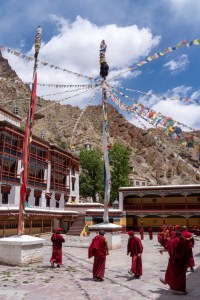
BIBLIOGRAPHY
Blumenthal, James. 2013. “Indian Mahāyāna Buddhism.” In A Companion to Buddhist Philosophy, edited by Steven M. Emmanuel, 86–98. Chichester, UK: John Wiley & Sons, Ltd. https://doi.org/10.1002/9781118324004.ch5.
Davidson, Ronald M. 2005. Tibetan Renaissance: Tantric Buddhism in the Rebirth of Tibetan Culture. New York: Columbia University Press.
Demiéville, Paul. 1952. Le Concile de Lhasa: Une Controverse Sur Le Quiétisme Entre Bouddhistes de l’Inde et La Chine Au VIII Siècle de l’ère Chrétienne. 1re éd. Vol. VII. Bibliothèque de l’Institut Des Hautes Études Chinoises. Paris: Imprimerie National de France.
Duckworth, Douglas S. 2017. “Grounds of Buddha-Nature in Tibet.” 불교학리뷰 (Critical Review for Buddhist Studies), no. 21 (June): 109–36. https://doi.org/10.29213/CRBS..21.201706.109.
Federman, Asaf. 2009. “Literal Means and Hidden Meanings: A New Analysis of Skillful Means.” Philosophy East and West 59 (2): 125–41. https://doi.org/10.1353/pew.0.0050.
Germano, David, and William S. Waldron. 2006. “A Comparison of Ālaya-Vijñāna in Yogācāra and Dzogchen.” In Buddhist Thought and Applied Psychological Research: Transcending the Boundaries, edited by D. K. Nauriyal, Michael S. Drummond, and Y. B. Lal, 36–68. Routledge Critical Studies in Buddhism. London; New York: Routledge.
Gregory, Peter N., ed. 1987. Sudden and Gradual: Approaches to Enlightenment in Chinese Thought. Studies in East Asian Buddhism 5. Honolulu: University of Hawaii Press.
Higgins, David. 2012. “An Introduction to the Tibetan Dzogchen (Great Perfection) Philosophy of Mind.” Religion Compass 6 (10): 441–50. https://doi.org/10.1111/rec3.12004.
Kapstein, Matthew T. 2011. “Buddhist Thought in Tibet: An Historical Introduction.” In The Oxford Handbook of World Philosophy, edited by William Edelglass and Jay L. Garfield. Oxford University Press. https://doi.org/10.1093/oxfordhb/9780195328998.003.0023.
Larson, Gerald James. 2009. “Differentiating the Concepts of ‘Yoga’ and ‘Tantra’ in Sanskrit Literary History.” Journal of the American Oriental Society 129 (3): 487– 498.
Padoux, André. 2002. “What Do We Mean by Tantrism?” In The Roots of Tantra, edited by Katherine Anne Harper and Robert L Brown, 17–24. Albany: State University of New York Press. http://site.ebrary.com/id/10587164.
Pettit, John W., and Mipham Gyatso. 1999. Mipham’s Beacon of Certainty: Illuminating the View of Dzogchen, the Great Perfection. Studies in Indian and Tibetan Buddhism. Boston: Wisdom Publications.
Powers, John. 2007. Introduction to Tibetan Buddhism. Rev. ed. Ithaca, N.Y: Snow Lion Publications.
Ruegg, David Seyfort. 2010. Buddhist Philosophy of the Middle: Essays on Indian and Tibetan Madhyamaka. Studies in Indian and Tibetan Buddhism. Boston: Wisdom Publications.
Samuel, Geoffrey. 1993. Civilized Shamans: Buddhism in Tibetan Societies. Washington DC: Smithsonian Institution Press.
Schaik, Sam van. 2004a. Approaching the Great Perfection: Simultaneous and Gradual Approaches to Dzogchen Practice in Jigme Lingpa’s Longchen Nyingtig. Boston. http://site.ebrary.com/id/10864059.
———. 2004b. “The Early Days of the Great Perfection.” Journal of the International Association of Buddhist Studies 27 (1): 165–206.
———. 2007. “The Great Perfection and the Chinese Monk: RNyingmapa Defences of Hwashang Mahāyāna in the Eighteenth Century.” 2007. http://earlytibet.com.
———. 2008a. “Early Dzogchen III: The Origin of Dzogchen?” Early Tibet (blog). January 24, 2008. https://earlytibet.com/2008/01/24/early-dzogchen-iii/.
———. 2008b. “Tibetan Chan III: More Teachings of Heshang Moheyan.” Early Tibet (blog). June 10, 2008. https://earlytibet.com/2008/06/10/tibetan-chan-iii-more- teachings-of-heshang-52moheyan/.
———. 2012. “Dzogchen, Chan and the Question of Influence.” Revue d’Etudes Tibétaines, no. 24 (October): 5–19.
———. 2015. Tibetan Zen: Discovering a Lost Tradition. First edition. Boston: Snow Lion.
———. 2016. The Spirit of Tibetan Buddhism. New Haven: Yale University Press. Snellgrove, David Llewellyn. 2004. Indo-Tibetan Buddhism: Indian Buddhists and Their Tibetan Successors. Bangkok: Orchid Press.
Sur, Dominic. 2015. “A Study of Rongzom’s Disclosing the Great Vehicle Approach (Theg Chen Tshul ‘jug) in the History of Tibet’s Great Perfection Tradition.” Charlottesville: University of Virgina.
———. 2017a. Entering the Way of the Great Vehicle: Dzogchen as the Culmination of
the Mahāyāna. Shambhala. http://www.myilibrary.com?id=988377.
———. 2017b. “Constituting Canon and Community in Eleventh Century Tibet: The Extant Writings of Rongzom and His Charter of Mantrins (Sngags Pa’i Bca’ Yig).” Religions 8 (3): 40. https://doi.org/10.3390/rel8030040.
Wangchuk, Dorji. 2003. “Lecture transcript: Einige Philosophische Grundlage der rDzogs-chen-Meditation.” In Buddhismus in Geschichte und Gegenwart, 8:165– 181. University of Hamburg. https://www.buddhismuskunde.uni- hamburg.de/en/publikationen/2-buddhismus-in-geschichte-und-gegenwart.html.
———. 2007. The Resolve to Become a Buddha: A Study of the Bodhicitta Concept in Indo-Tibetan Buddhism. Studia Philologica Buddhica, XXIII. Tokyo: The International Institute for Buddhist Studiies.
———. 2013. “On the Status of the Yogācāra School in Tibetan Buddhism.” In The Foundation for Yoga Practitioners: The Buddhist Yogācārabhūmi Treatise and Its Adaptation in India, East Asia, and Tibet, edited by Ulrich Timme Kragh, 1316– 1328. Harvard Oriental Series 75. Cambridge: Harvard University Press.
———. 2017. “Rong-Zom-Pa’s Ontological Abyss: Where the Positivistic Ontology of the Tathāgatagarbha School and the Negativistic Ontology of the Sarvadharmāpratiṣṭhānavāda School Meet.” 불교학리뷰 (Critical Review for Buddhist Studies), no. 21 (June): 85–107. https://doi.org/10.29213/CRBS..21.201706.85.
 Espejo Sideral
Leave a comment