
Presenting a definition of tantra is not an easy task due to the variety of usages in Sanskrit literature. Moreover, there have been numerous academic attempts at defining tantra as a way of doing spiritual practice. In this short article, I review two kinds of definitions: from the tradition itself, and from the work of several modern scholars.
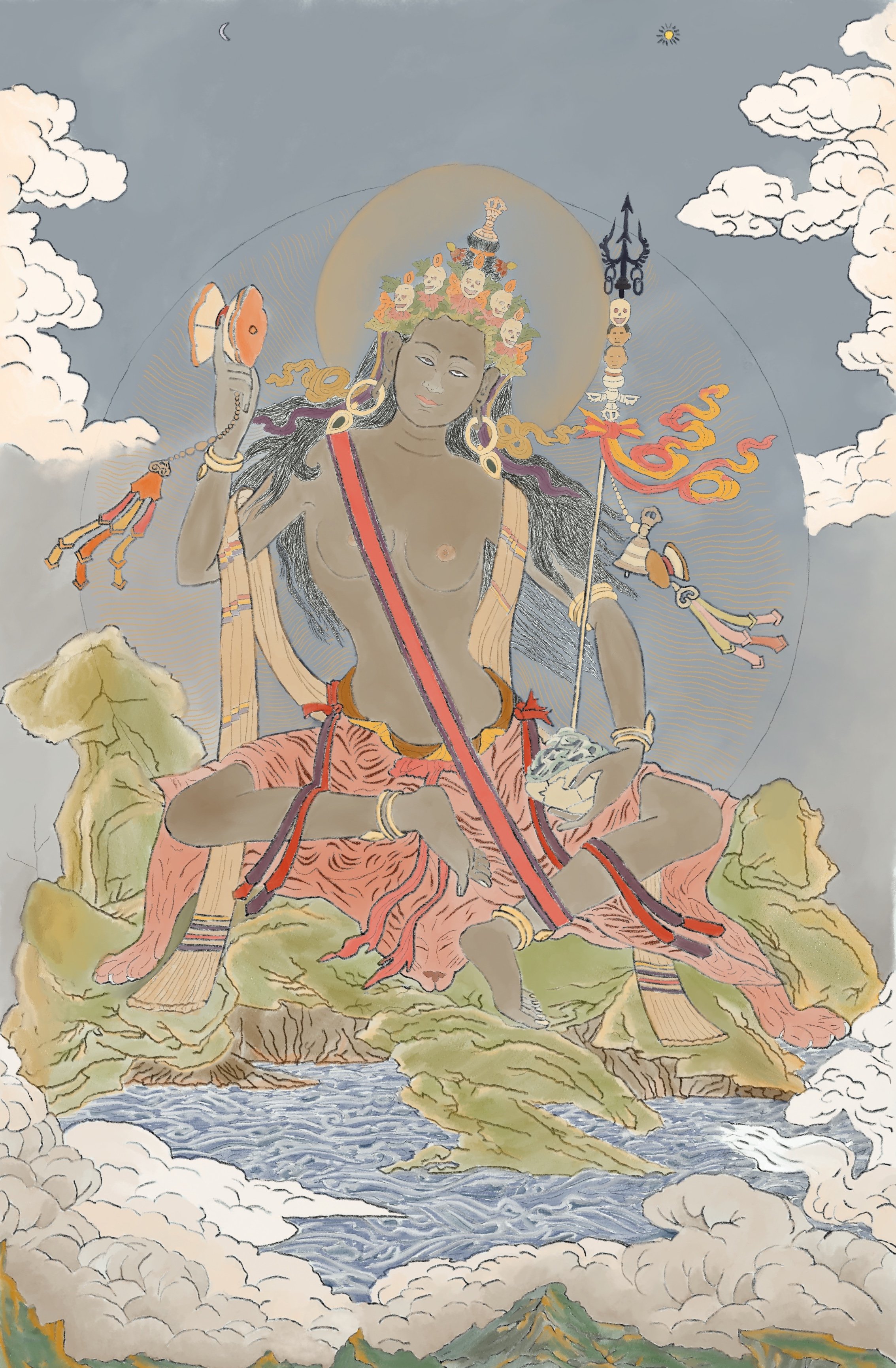
Digital illustration by the author – © Nicolás Arias-Gutiérrez
Some Usages of the Word Tantra in Sanskrit Literary History
Gerald Larson traces the first use of the word tantra to the Ṛg Veda, where it is used only once, in the sense of a loom and the fabric on it. [1] The term tantra, from the verbal root tan, was used in later Sanskrit intellectual history to refer to a means for “extending” or “stretching”.[2] In intellectual settings, tantra appears to have meant a “learned system or śastra in which all of the parts are placed in their proper systematic place.” Some examples are Pātañjala yoga, the āyurveda of Caraka and Suśruta, and the vyākaraṇa (Sanskrit grammar) of Pāṇini.[3]
Another related usage is revealed in a distinction found in the Sanskrit tradition between the terms vaidika and tāntrika. According to André Padoux, these two categories were understood as referring to two forms of approaching the ultimate reality, differentiated by whether the revelation was formally rooted in the Brahmanic tradition or not.[4] Larson suggests that the term vaidika was used in the sense of “conventional” or “traditional,” and not so much in the sense of “Vedic.”[5]
For the purposes of this article, the most important usage of the word tantra is related to a genre of literary works that proliferated across various sectarian circles in Asia, beginning around the 6th century CE. This usage is reflected in one of the definitions of tantra found in Monier-Williams’ dictionary: “magical and mystical formularies.”
Even though abstract, general definitions related to this last usage are rare in the tradition itself, Christopher Wallis highlights one instance in the work of Tantrik scholar and guru Rāma Kaṇṭha, who lived around 950–1000 CE. What follows is Wallis’ English rendering of the Sanskrit original from the commentary on the Sārdhatriśati-kālottara:
A Tantra is a divinely revealed body of teachings, explaining what is necessary and what is a hindrance in the practice of the worship of the Divine; and also describing the specialized initiation and purification ceremonies that are the necessary prerequisites of Tantrik practice. These teachings are given to those qualified to pursue both the higher and lower aims of human existence.[6]
“Tantrism”: Academic Definitions of Tantra as a Way of Doing Spiritual Practice
Western Indologists began to study some of these texts by the end of the 19th century, and the term “Tantrism” was eventually coined. Even though the texts themselves often didn’t identify as tantras (but as āgamas, for example), scholars identified some shared characteristics that seemed to set them apart from the more orthodox Indian philosophy and religion with which they were more familiar.[7] Rāma Kaṇṭha’s traditional definition is based on a dualist śaiva framework, but there are texts that have been labeled as having “tantric” characteristics in both dualist and nondualist traditions, across śaiva, śakta, Buddhist, vaiṣṇava, and even Jain circles.
In his critique of the term “Tantrism,” Padoux argues that it is an attempt to demarcate a phenomenon that cannot be neatly defined. Research over the past century seems to point to a phenomenon that is “vast, diffuse, diverse and very difficult to define satisfactorily”[8]:
Depending upon the background, the origins, and the local influences, the evolution was more or less marked by a rejection of the orthodox Vedic rules and notions; it included more or less local autochthonous cults and beliefs, local religious behaviors, and magical and/or other practices.[9]
Academic definitions of tantra or “Tantrism” are still informative and may be useful for specific purposes. The term “Tantricization” has also been suggested as a useful lens. Wallis crafted a valuable “master-list” of characteristics of tantra based on the work of five prominent scholars (Tribe, Hodge, Goudriaan, Brooks, and Lopez):
• alternative path / new revelation / more rapid path
• centrality of ritual, esp. evocation and worship of deities
• proliferation in the number and types of deities (compared to the antecedent tradition)
• visualization and self-identification with the deity
• centrality of mantras
• installation of mantras on specific points of the body
• ontological identity of mantras and deities
• necessity of initiation and importance of esotericism/secrecy
• yoga (usually referring to meditation and visualization practices)
• ritual use of maṇḍalas, especially in initiation
• spiritual physiology (i.e. subtle body and cakras) and kuṇḍalinī
• mapping deities and pilgrimage sites onto the practitioner’s body
• linguistic mysticism
• importance of the teacher (guru, ācārya)
• addition of worldly aims, achieved through largely magical means
• lay/householder practitioners
• bipolar symbology of god/goddess[10]
Wallis references Rāma Kaṇṭha’s definition of tantra and argues that the pursuits of both worldly goals and liberation are combined in tantric practice.[11] This is not the same as the exclusive pursuit of worldly aims (for example, the sole pursuit of pleasure that often characterizes forms of what has been termed “Neo-Tantra.)” Wallis suggests that the following ten features only apply to “nondualist” Tantra:
• nondualism
• revaluation of the body
• revaluation of “negative” mental states
• importance of śakti (power, energy, goddess)
• revaluation of the status and role of women
• transgressive/antinomian acts
• utilization of “sexual yoga”
• the cultivation of bliss
• spontaneity (sahaja, a technical term)
• special types of meditation that aim to transform the individual into an embodiment of the divine after a short span of time.[12]
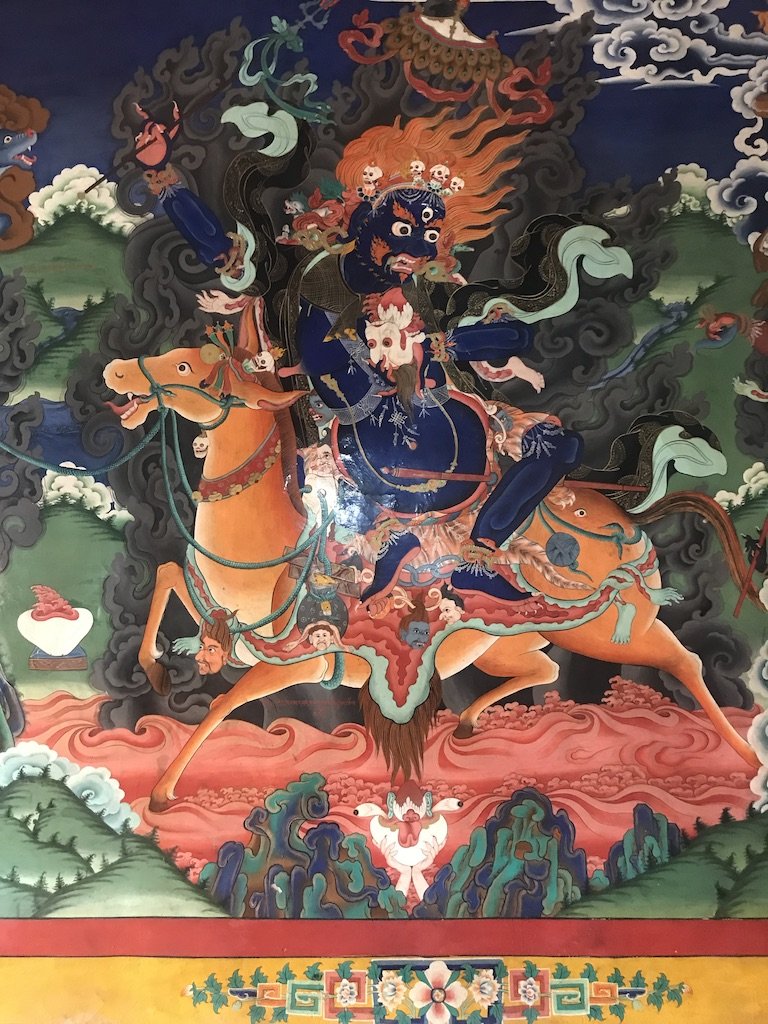
Digital photography by the author – © Nicolás Arias-Gutiérrez
Antinomianism in Tantra
Westerners often express curiosity about forms of tantra that incorporate what appear to be transgressive features. These are mainly found in some groups and texts of the śaiva-śākta traditions of the kāpālika strand, some of the nātha, the sahajiyā vaiṣṇavas, and some tantric forms of mahāyāna Buddhism.[13] Padoux refers to some of these forms as “hard core tantrism,” a notion defined in terms of the following five features: (i) often transgressive practices that are (ii) given meaning by a more or less power-oriented vision of micro-macrocosmic correspondences whereby power is manipulated, (iii) usually highly esoteric, (iv) related to particular types of pantheons, and (v) having specific and very developed types of ritual.[14]
Transgressive or antinomian practices, such as ritual engagement of the senses with that which is conventionally considered impure (see below), are often referred to as “left-handed” (vāmācāra). In contrast, “right-handed practices” (dakṣiṇācāra) do not stand in opposition to traditional mores and customs. It is unclear whether (a) these practices were at some point stripped of the more transgressive elements, if (b) they originated instead in ascetic, celibate traditions and were then co-opted by “left-handed” tantra practitioners, or if (c) both traditions coexisted and evolved simultaneously.
Verse 101 of the Gorakṣaśataka, a traditional haṭha yoga text (c. 13th century), appears to present an alternative interpretation of some of the five transgressive practices of the tantric pañcamakāra ritual. The following practices are explicitly presented in an “internalized” form: (i) drinking wine as drinking the nectar of immortality flowing from the head (referred to as bindu), (ii) eating meat as disengagement of the senses; and (iii) sex as the process of dissolution, brought about by making energy flow through the subtle central channel.[15]
Surviving Lineages of Tantra
The most visible living traditions that display significant tantric features are perhaps vajrayāna Buddhism and nondual śaiva-śakta tantra. Associated with the symbol of the indestructible and powerful vajra, Tantric Buddhism is said to employ myriad embodied practices to bring about altruistic enlightenment in considerably less time than other paths. Closely related, and revived through the teachings of the Kashmiri master Swami Lakshmanjoo, the nondual Trika tantra of the śaiva-śakta tradition is known for its emphasis on direct experience of the Divine in its transcendent and immanent aspects. Recent research on traditional haṭha yoga has also uncovered what appear to be tantric characteristics, not often present in transnational postural yoga. Instead of advocating an isolation (kaivalyam) of the transcendent self, nondual tantric traditions value embodied processes of transformation of mental-emotional life towards a place of wisdom, which can be conducive to ethical engagement.[16]
NOTES
[1] Gerald Larson. “Differentiating Yoga from Tantra.” Journal of the American Oriental Society, 129 (3): 487-98. (2009: 490).
[2] Larson (2009: 490).
[3] Larson (2009: 490).
[4] André Padoux. “What do We Mean by Tantrism.” The Roots of Tantra, edited by Katherine Anne Harper and Robert L. Brown. New York: SUNY Press (2002: 18).
[5] Gerald Larson. “Differentiating Yoga from Tantra.” Journal of the American Oriental Society, 129 (3): 487-98. (2009: 491).
[6] tantraṃ ca—parāpara-puruṣārthādhikāriṇāṃ viśiṣṭa-saṃskāra-pratipādana-pūrva[ka]m īśvarārādhanāya niyata-vidhi-niṣedhaṃ tadājñātmakaṃ vākya-jātam. Christopher D. Wallis. Tantra Illuminated: the philosophy, history, and practice of a timeless tradition. Petaluma: Mattamayūra Press (2013: 28).
[7] André Padoux. “What Do We Mean by Tantrism.” The Roots of Tantra, edited by Katherine Anne Harper and Robert L. Brown. New York: SUNY Press (2002: 17).
[8] Padoux (2002: 17).
[9] Padoux (2002: 23).
[10] Christopher D. Wallis. Tantra Illuminated: the philosophy, history, and practice of a timeless tradition. Petaluma: Mattamayūra Press (2013: 33).
[11] Wallis (2013: 29, 40).
[12] Wallis (2013: 33-4).
[13] André Padoux. “What Do We Mean by Tantrism.” The Roots of Tantra, edited by Katherine Anne Harper and Robert L. Brown. New York: SUNY Press (2002: 22).
[14] Padoux (2002: 22).
[15] “We drink the dripping liquid called bindu, “the drop,”not wine; we eat the rejection of the objects of the five senses, not meat; we do not embrace a sweetheart [but] the Suṣumnā nāḍī, her body curved like kuśa grass; if we have intercourse +. . . + it takes place in a mind dissolved in the void, not in a vagina.” James Mallinson. “Śaktism and Haṭha Yoga” Goddess Traditions in Tantric Hinduism: History, Practice and Doctrine, edited by Bjarne Wernicke Olesen. London: Routledge (2016: 123).
[16] See, David Gordon White. “‘Open’ and ‘Closed’ Models of the Human Body in Indian Medical and Yogic Traditions”. Asian Medicine, 2 (1): 1-13. (2006:11-2).
 Espejo Sideral